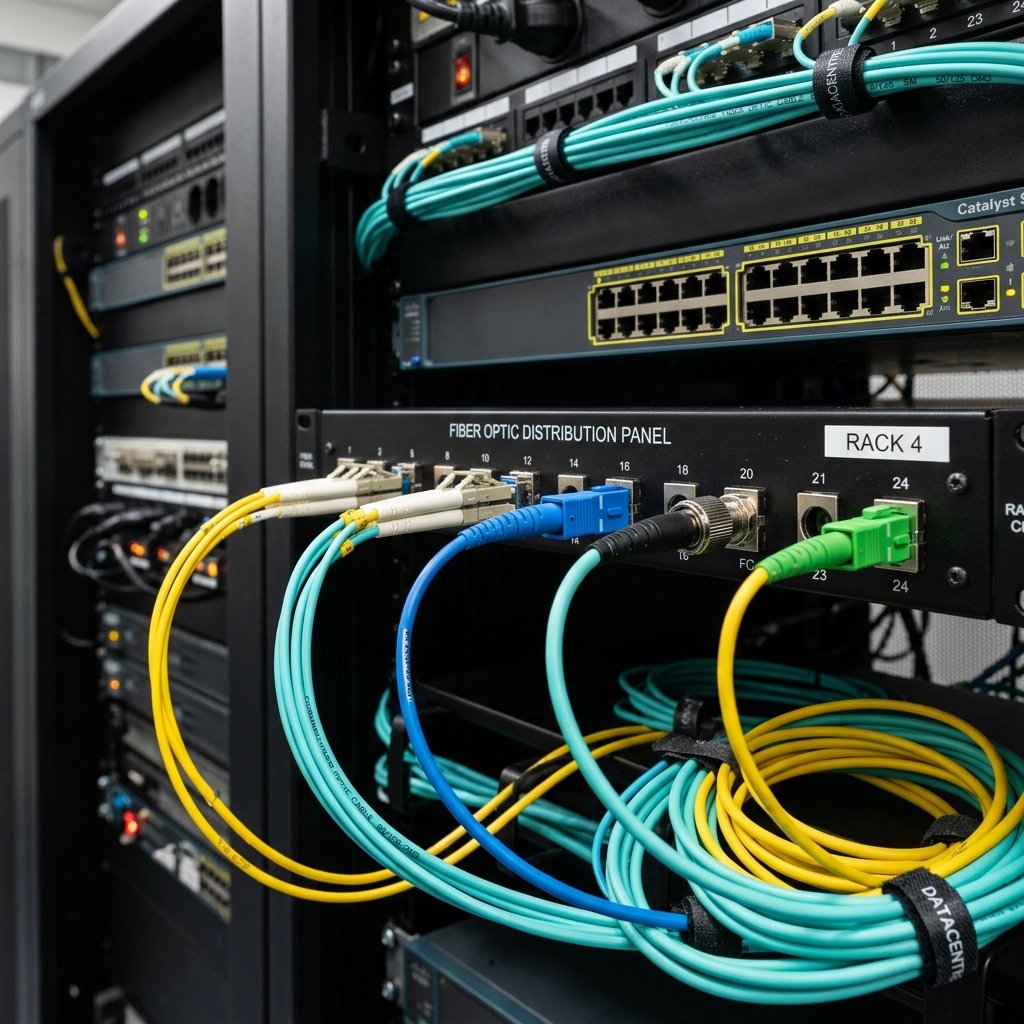
Introduction
Fiber optic cables are the backbone of today's high-speed global internet. These cables are categorized into two primary types: Single-Mode (SMF) and Multi-Mode (MMF). Let's explore the core differences.
Single-Mode Fiber (SMF)
Single-mode fiber features a tiny glass core (around 9 microns in diameter) that allows only a single pathway of light (laser beam) to propagate. This minimizes signal attenuation and reflections over long distances.
Usage: Best suited for long-distance telecommunications, transoceanic cables, and connecting cities over dozens of kilometers.
Multi-Mode Fiber (MMF)
Multi-mode fiber has a larger core (typically 50 or 62.5 microns) that permits multiple paths of light (LED source) to travel simultaneously. While highly effective, it suffers from modal dispersion over long distances.
Usage: Primarily used for short-range deployments (under 2 km) such as local enterprise networks, office buildings, and data centers.
Summary Comparison:
- Distance Limit: Single-mode handles distances up to 40km+, while multi-mode is optimized for short runs under 2km.
- Light Source: Single-mode uses Lasers, whereas multi-mode relies on cost-efficient LEDs.
- Cost: Single-mode cables are cheap but laser equipment is pricey. Multi-mode systems are much more cost-effective for short-range building setups.